


Latest posts:
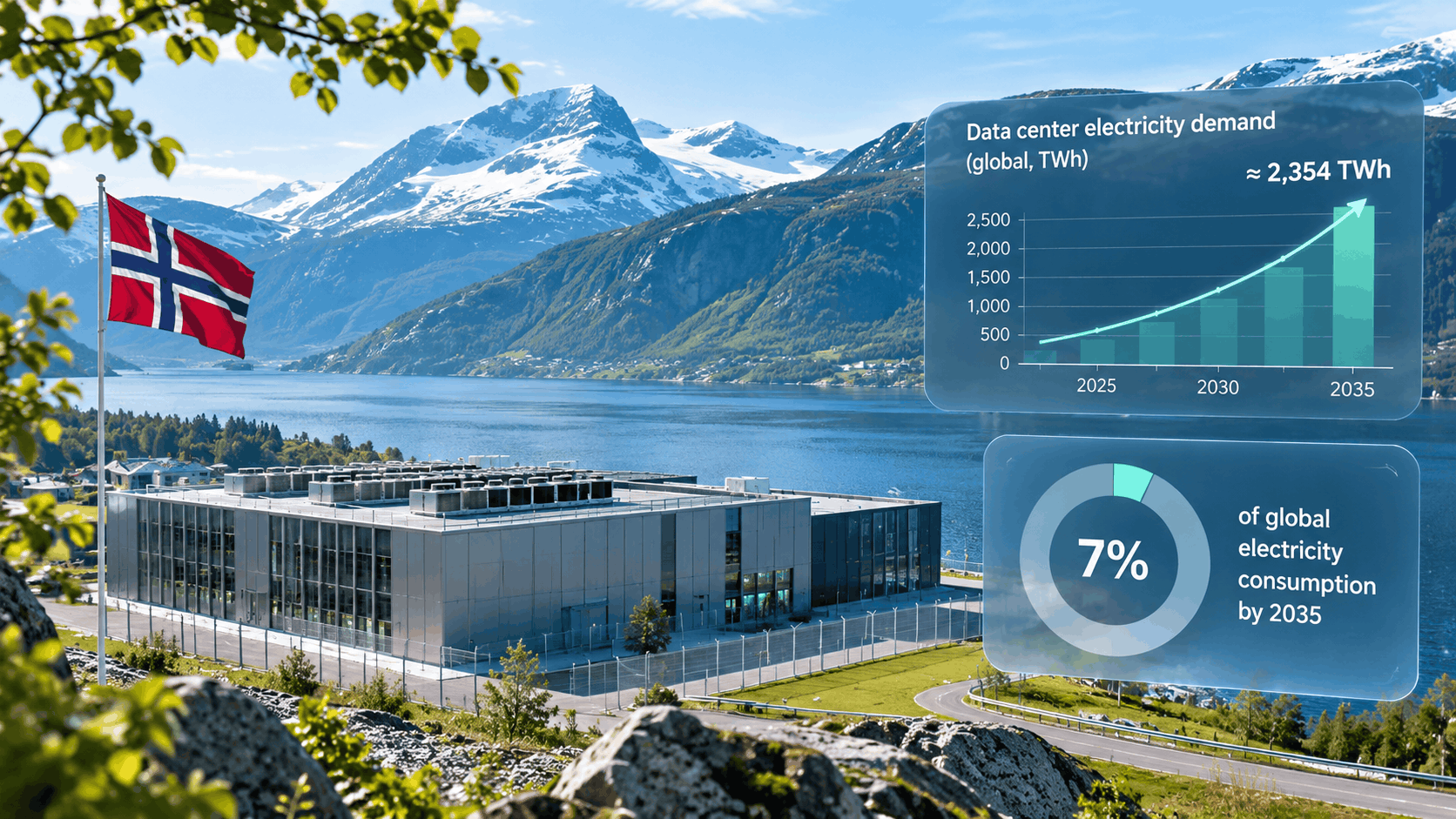
Norway Restricts Data Center Expansion
Norway has temporarily suspended new electricity grid capacity reservations for data centers, highlighting a growing challenge for the global technology industry: computing infrastructure is expanding faster than energy networks can support it.
On November 9, 2026, Norwegian transmission system operator Statnett announced restrictions on new grid capacity reservations and certain technical approvals for data center projects. The measures are intended to protect the stability of the national power system and are expected to remain in place until August 1, 2027, at the latest.
The decision comes as demand for computing capacity continues to accelerate, largely driven by artificial intelligence, cloud services and the construction of increasingly powerful data centers.
Demand Is Exceeding Available Capacity
According to Statnett, Norwegian data centers currently use approximately 800 MW of connected grid capacity. Another 4,200 MW has already been reserved, while projects requiring 9,100 MW are waiting in the capacity queue. Additional connection requests total 18,000 MW.
For comparison, Norway's maximum national electricity demand is slightly above 25,000 MW. The scale of proposed data center development therefore represents a substantial challenge for the country's electricity infrastructure.
The restrictions do not mean that existing data centers must shut down. Facilities already connected to the grid remain unaffected, and projects with the necessary technical approvals may still proceed.
Statnett also emphasizes that the challenge is not limited to the amount of electricity required. Data centers can generate rapid changes in power consumption, making the stability and technical management of the electricity grid increasingly important.
Norway has traditionally been considered an attractive destination for data centers because of its relatively cool climate, access to renewable electricity and established energy infrastructure. However, these advantages are no longer enough to guarantee unlimited expansion.
Global Electricity Demand Could Nearly Quadruple
The Norwegian decision coincides with a new report published by BloombergNEF on November 11, 2026. According to its projections, global electricity consumption by data centers could increase almost fourfold by 2035, reaching 2,354 terawatt-hours annually.
That would represent approximately 7% of global electricity consumption.
The report identifies electricity grid limitations as an increasingly important obstacle to data center development, particularly in Europe and the United States.
Some operators are already exploring alternative power sources to avoid lengthy grid connection delays. BloombergNEF has identified 181 GW of announced gas-fired generation projects associated with data centers, with more than 90% of that capacity located in the United States.
However, these announcements do not necessarily mean that all projects will be completed. Building independent power generation facilities also introduces additional costs, environmental concerns and long-term infrastructure commitments.
What Does This Mean for the Hosting Industry?
For hosting providers and cloud infrastructure operators, electricity availability is becoming an important factor alongside hardware costs, network connectivity and physical security.
Expanding a data center is no longer simply a matter of installing additional server racks. Operators must also secure sufficient electrical capacity, cooling infrastructure and reliable connections to the power grid.
Limited power availability could have several consequences for the hosting industry:
- Delays in the construction and expansion of data centers.
- Higher operating costs in regions with limited electricity capacity.
- Potential increases in the cost of cloud computing, dedicated servers and other hosting services.
- Greater emphasis on energy-efficient hardware and infrastructure.
- Growing interest in locations with reliable and affordable electricity supplies.
These developments could also encourage hosting providers to improve the efficiency of existing infrastructure, optimize server utilization and reconsider where new facilities should be built.
A New Challenge for European Digital Infrastructure
Norway's decision illustrates a broader shift in the technology industry. For years, data center expansion was primarily associated with investments in processors, storage and networking equipment. Electricity supply is now becoming an equally important constraint.
The temporary restrictions introduced by Statnett are intended to provide time for developing new technical requirements for data center connections. These include rules governing rapid changes in electricity consumption and how facilities respond to disturbances in the power system.
As demand for artificial intelligence and cloud computing continues to grow, access to reliable and affordable energy may increasingly determine which European locations can support new digital infrastructure.
For the hosting industry, the challenge is not only to build more computing capacity, but to make better use of the resources already available.
Sources: Statnett, November 9, 2026; BloombergNEF, November 11, 2026.
 Telegram Chat